Monographs
2014. Diagnosing the Diagnostic and Statistical Manual of Mental Disorders. Karnac. (Japanese translation 2015).

2007. Psychiatry and the Philosophy of Science. Routledge.

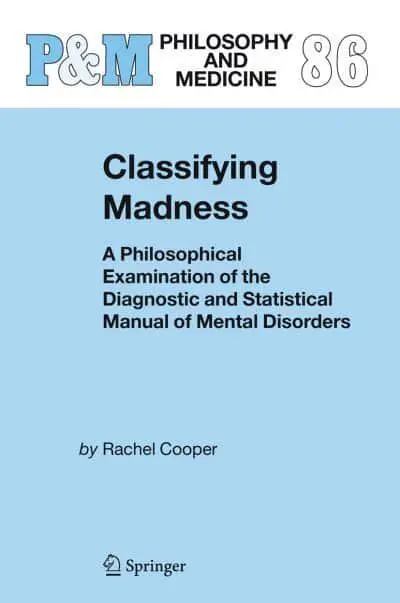
2005. Classifying Madness: A philosophical examination of the Diagnostic and Statistical Manual of Mental Disorders. Springer.
Edited collections
2012 (with Havi Carel) Health, Illness and Disease: Philosophical Essays. Routledge.

2010 (with Havi Carel) Culture Bound Syndromes. Special issue of Studies in History and Philosophy of Biological and Biomedical Sciences. Vol. 41.
2007. (with Chris Megone) The Concept of Disease. Special issue of Philosophical Papers. Vol. 36.
Journal papers
2026. The conceptual evolution of exclusion rules in the DSM: Problems with determining when one diagnosis should rule out another. Studies in History and Philosophy of Science. 116: 102107.
2020. The concept of disorder revisited: Robustly value-laden despite change. Aristotelian Society Supplementary Volume. 90: 141-161.
2018. (with Roger Blashfield) The myth of Hempel and the DSM-III. Studies in History and Philosophy of Science Part C: Studies in History and Philosophy of Biological and Biomedical Sciences. 70: 10-19
2018. Diagnostic and Statistical Manual of Mental Disorders (DSM). Knowledge Organization. 44: 668-676.
2018. Understanding the DSM-5: Stasis and change. History of Psychiatry.29: 49-65.
2017. Where’s the problem? Considering Laing and Esterson’s account of schizophrenia, social models of disability, and extended mental disorder. Theoretical Medicine and Bioethics 38:295-305.
2016. First do no harm? What role should considerations of potential harm play in revising the DSM? Philosophy, Psychiatry and Psychology 23: 103-113.
2016. Re-evaluating the DSM-I. (with Roger Blashfield, 50-50 contribution). Psychological Medicine. 46: 449-456.
2015. How might I have been? Metaphilosophy. 46: 495-514.
2015. Why is the Diagnostic and Statistical Manual of Mental Disorders so hard to revise? Path-dependence and “lock-in” in classification. Studies in History and Philosophy of Science Part C: Studies in History and Philosophy of Biological and Biomedical Sciences. 51: 1-10.
2014. Shifting boundaries between the normal and the pathological: The case of mild intellectual disability. History of Psychiatry. 25: 171-186.
2014. On deciding to have a lobotomy: either lobotomies were justified or decisions under risk should not always seek to Maximise Expected Utility. Medicine, Healthcare and Philosophy. 17: 143-154.
2013. Avoiding false positives; the role of zones of rarity, the threshold problem, and the DSM clinical significance criterion. Canadian Journal of Psychiatry. 58: 606-611.
2012. Psychiatric classification and subjective experience. Emotion Review. 4:197-202.
2010. Are culture-bound syndromes as real as universally-occurring disorders? Studies in History and Philosophy of Biological and Biomedical Sciences. 41: 325-332.
2007. Can it be a good thing to be Deaf? Journal of Medicine and Philosophy. 32: 563-583.
2007. Aristotelian accounts of disease – what are they good for? Philosophical Papers. 36:427-442.
2005. Thought experiments. Metaphilosophy. 36: 328 -347.
2004. Why Hacking is wrong about human kinds. British Journal for the Philosophy of Science. 55: 73-85.
2004. What is wrong with the DSM? History of Psychiatry. 15: 5-25.
2004. Can sociologists understand other forms of life? Perspectives on Science. 12: 29-54.
2002. Disease. Studies in History and Philosophy of Biological and Biomedical Sciences. 33: 263-282.
Book chapters
2026. Fact, value, and disorder. In Oxford Handbook of Philosophy of Medicine. Broadbent, A (Ed.). Oxford University Press.
2025. Problems in psychiatric nosology. In Handbook of the Philosophy of Medicine (2nd ed. ed.). Schramme, T & Walker, M (Eds) Springer.
2024. Psychiatric kinds and the DSM: Notes from a conceptual building site. In New Perspectives on Conceptual Engineering: Foundational Issues. Isaac, M. & Scharp, K. (Eds.), Springer.
2021. Reasons to expect psychopathy and antisocial personality disorder (ASPD) to vary across cultures. In Psychopathy: Its Uses, Validity and Status. Malatesti, L., McMillan, J. & Šustar, P. (Eds.), Springer.
2021. On harm. In Defining Mental Disorders: Jerome Wakefield and his Critics. Faucher, L. & Forest, D. (eds.) MIT Press.
2020. When answers are hard to find, change the question: Asking different causal questions can enable progress. In Rethinking Biopsychosocial Psychiatry. Savulescu, J. (ed.) Oxford University Press.
2017. Classification, rating scales, and promoting user-led research. In Extraordinary Science and Psychiatry: Responses to the Crisis in Mental Health Research. Poland, J & Tekin, S. (eds.) MIT Press. pp.197-220.
2017. Health and disease. In The Bloomsbury Companion to Contemporary Philosophy of Medicine. Marcum, J. (ed.) Bloomsbury. pp.275-296.
2014. Must disorders cause harm?: the changing stance of the DSM. In The DSM-5 in Perspective. Singy, P. & Demazeux, S. (eds.). Springer. pp.83-96.
2013. What’s special about mental health and disorder? In Arguing About Human Nature. Machery, E. and Downes, S. (eds.) Routledge. pp.487-500.
2013. Natural kinds. In Oxford Handbook of Philosophy and Psychiatry. Fulford, K., Davies, M., Graham, G., Sadler, J, Stanghellini, G. & Thornton, T. (eds.) Oxford University Press. pp.950-964.
2013. (with Havi Carel) Introduction. In Health, Illness and Disease: Philosophical Essays. Carel, H. & Cooper, R (eds.) Acumen. pp.1-20.
2012. Being ill and getting better: recovery and accounts of disorder. In The Recovery of People with Mental Illness. Rudnick, A. (ed.) Oxford University Press. pp.217-235.
2012. Is psychiatric classification a good thing? In Philosophical Issues in Psychiatry II: Nosology. Kendler, K. and Parnas, J. (eds.). Oxford University Press. pp.61-70.
2012. Comments on Zachar. Progress and the calibration of scientific constructs: a new look at validity. In Philosophical Issues in Psychiatry II: Nosology. Kendler, K. and Parnas, J. (eds.). Oxford University Press. pp.35-40.
2012. Complicated grief: Philosophical perspectives. In Complicated Grief: Scientific Foundations for Health Care Professionals. Stroebe, M., Schut, H., Boelen, P. & van den Bout, J. (eds.) Routledge. pp.13-26.
2012.Can it be a good thing to be Deaf? Revised version of (2007) Journal of Medicine and Philosophy. 32: 563-583. In Deaf Epistemologies. Paul, P. and Moores, D. (eds.) Gallaudet Press.
2011. Mental health and disorder. In The Sage Handbook of Health Care Ethics. Chadwick, R., ten Have, H. and Meslin, E. (eds.) Sage. pp.251-260.
2009. Is psychiatric research scientific? In Psychiatry as Cognitive Neuroscience. Broome, M. and Bortolotti, L. (eds.) Oxford University Press. pp.13-28.
2008. Are there natural kinds in psychology? In Revitalising Causality. Groff, R. (ed.) Routledge. pp.179-192.
2005. (with Mark Pollard and Robin Coningham). What value a unicorn’s horn? A study of archaeological uniqueness and value In Ethics and Archaeology. Scarre, G. and Scarre, C. (eds.) Cambridge University Press
Short/ invited publications
2025. (with Jacob Barlow) Book Review of Alan Horwitz DSM: A History. British Journal for the History of Science 58, Special Issue 2: 353-354.
2019. Commentary on Jonathan Raskin’s ‘What might an alternative to the DSM suitable for psychotherapists look like?’ Journal of Humanistic Psychology. 59, 3
2017. Socratic questioning in Alien Landscapes. Journal of Applied Philosophy. 34: 724-729.
2017. A modest proposal: commentary on “A role for philosophers, sociologists and bioethicists in revising the DSM” Philosophy, Psychiatry and Psychology. 24: 207-209.
2017. Doing without A Metaphysics of Psychopathology. Bulletin of the Association for the Advancement of Philosophy and Psychiatry. 24: 10-12.
2015. (With C. Blease) Kuhn. In The Encyclopedia of Clinical Psychology. Cautin, R. & Lilienfeld, S. (eds.). Wiley-Blackwell. pp. 1640-1644.
2015. (With C. Blease) Kuhn’s paradigms. In The Encyclopedia of Clinical Psychology. Cautin, R. & Lilienfeld, S. (eds.). Wiley-Blackwell. Pp. 1632-1640.
2015. (With C. Blease) Quine-Duhem thesis. In The Encyclopedia of Clinical Psychology. Cautin, R. & Lilienfeld, S. (eds.). Wiley-Blackwell. pp. 984-988.
2014. Book Review of Peter Zachar A Metaphysics of Psychopathology. Psychological Medicine. 44, 14, p. 3135-3135. 1 p.
2012. Disease mongering. In International Encyclopaedia of Ethics. LaFollette, H. (ed.). Wiley-Blackwell.
2011. Some classifications will be natural. Forum on philosophy of classification Knowledge Organisation. 38: 398-404
2011. Illness or moral failing? The Philosophers’ Magazine. 55: 43-47